CBO vs ABO for Dropshipping: Which Budget Strategy Wins in 2026?
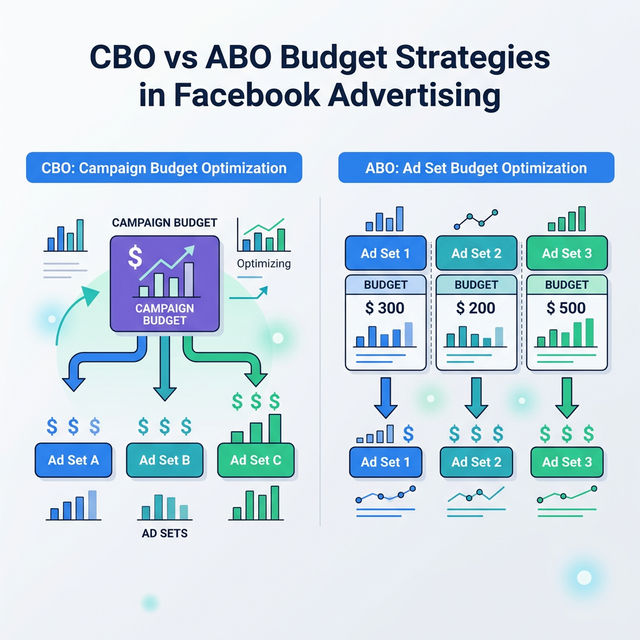
You launch a new product with Campaign Budget Optimization (CBO) turned on. Meta spreads your $200 across five ad sets. Three days later, only one ad set got any spend. The others sat at $0.
Or you run Ad Set Budget Optimization (ABO), manually setting $40 per ad set. All five spend evenly. But two weeks in, you’re still testing instead of scaling because you’re spreading budget too thin and can’t isolate the winner.
Both scenarios burn money. You’re using the wrong budget method at the wrong stage.
What CBO and ABO Actually Do
- ABO (Ad Set Budget Optimization): You manually set budgets for each ad set. If you create five ad sets with $40 each, Meta spends exactly $40 on each. You control distribution.
- CBO (Campaign Budget Optimization): You set one budget at the campaign level. Meta decides how to distribute that budget across ad sets based on predictions. Meta controls distribution.
During testing (days 1-7), you need clean data. ABO guarantees every ad set gets an equal chance. During scaling (days 8+), you need the algorithm to push budget toward winners. CBO does this automatically.
Phase 1: When to Use ABO for Testing (Days 1-7)
ABO is for gathering data, not scaling.
Testing new products: Create 3-5 ad sets with different creatives or audiences. Set each to $30-50/day using ABO. Run for 48-72 hours. ABO ensures each variation receives enough spend to prove whether it works. Learn how to write converting ad copy for these creatives.
Testing new creatives on proven products: Set up 3-5 ad sets, each with a different creative variation. Give each $40/day for 48 hours. Compare CTR and CPA. The winner becomes your new control.
If you test using CBO, Meta might spend 90% of your budget on one ad set just because it got an early like, leaving you with incomplete data on 80% of your tests.
Phase 2: When to Switch to CBO for Scaling
CBO is for scaling proven winners, not discovering them.
Switch to CBO only after ad sets consistently hit these benchmarks:
- CTR above 2%
- CPA below your target (usually 1.5-2.5x product cost)
- At least 5-10 purchases
Create a new CBO campaign. Don’t toggle ABO to CBO on your existing campaign—Meta’s algorithm treats it as a new campaign anyway and resets learning. Only put your proven winners into this new CBO.
Start at 1.5-2x your ABO test budget. If you tested 5 ad sets at $40/day ($200 total), launch CBO at $300-$400/day.
The Testing Framework Decision Tree
Follow this exact sequence for every new product launch:
Days 1-3 (ABO Testing)
- Create 3-5 ad sets ($30-50/day each).
- Let them spend fully for 48-72 hours.
- Pause losers (CTR <1.5% or CPA >3x target).
Day 4-7 (ABO Validation)
- Keep running the 1-3 winners at $40-60/day.
- Confirm consistency over the next few days.
- Collect at least 10-15 purchases per winner.
Day 8+ (CBO Scaling)
- Create a new CBO campaign with validated ad sets only.
- Set campaign budget to 1.5-2x total ABO spend.
- Set a Cost Cap at 1.2-1.5x your target CPA to prevent runaway spend.
- Scale budget up by 20-30% every 3-4 days if CPA holds.
Common CBO Mistakes That Kill Campaigns
- Using CBO to test new products. Meta will spend randomly, and you will kill campaigns early believing the product is a “loser.”
- Setting CBO budget too low. A $50/day CBO across four ad sets is useless. The algorithm needs volume. CBO should have a $100-$150/day absolute minimum.
- Mixing tested and untested ad sets. If you mix a proven winner with three untested creatives in a CBO, Meta will starve the untested ones. Keep testing and scaling campaigns strictly separated.
- Turning CBO on and off. Toggling resets the learning phase. Commit to it for at least 7 days.
What to Do When CBO Stops Working
CBO campaigns eventually plateau. Creative fatigue hits (frequency climbs above 3), audience saturation occurs, or you hit the efficiency ceiling for your daily budget.
When this happens, follow the recovery sequence:
- Return to ABO. Pause the dying CBO. Launch a new ABO campaign with 3-5 fresh creatives. Find the new winner.
- Launch a new CBO. Create a fresh CBO campaign (do not reactivate the old one) using the new winning creatives. Start at your previous working budget level.
- Test new audiences. If new creatives fail, test new lookalikes or broad targeting. Before spending more money, make sure you’ve validated demand with free methods.
Cycle complete: ABO tests new angles → CBO scales winners → performance plateaus → return to ABO for refresh. Plan for this every 14-21 days.
Frequently Asked Questions
Should I use CBO or ABO for dropshipping?
Use ABO (Ad Set Budget Optimization) to test new products or creatives for 48-72 hours. Switch to CBO (Campaign Budget Optimization) to scale winners once you hit a 2%+ CTR and a profitable CPA.
Why does CBO spend all budget on one ad set?
CBO distributes budget based on predicted performance. If one ad set converts better early, Meta pushes more budget there. This is intended behavior during scaling.
How much should I spend on ABO testing?
$30-50 per ad set per day, testing 3-5 ad sets simultaneously (total $150-250/day). Run for 48-72 hours minimum.
When should I switch from ABO to CBO?
Switch after validating winners: 2%+ CTR, profitable CPA, and 10-15+ purchases. Start your CBO campaign at 1.5-2x your ABO budget and scale 20-30% every few days.
What do I do when CBO stops working?
Return to ABO to test 3-5 new creatives at $40-50/day. Creative fatigue hits every 14-21 days during aggressive scaling. Find new winners, then launch a fresh CBO campaign.