Dropshipping Customer Service: Cut Support Time to 2 Hours/Day (2026)
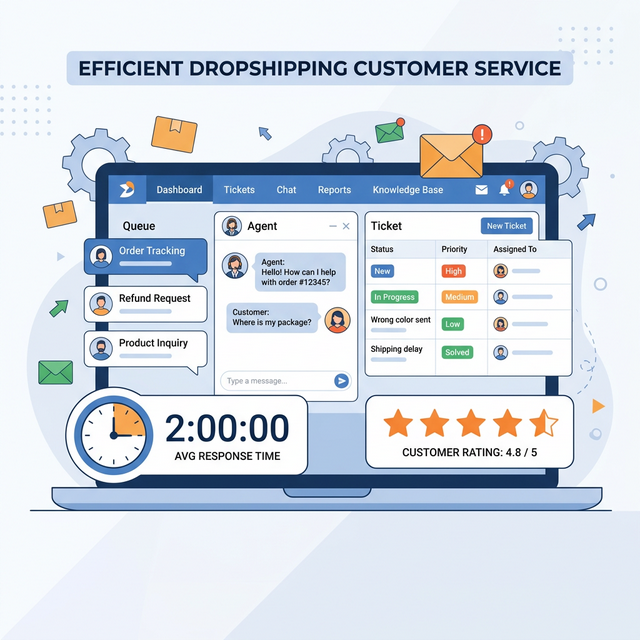
Dropshipping customer service consumes 3-5 hours daily answering the same questions repeatedly: “Where’s my order?” “How do I return this?” “Why hasn’t it shipped yet?”
Every support ticket interrupts product research, ad optimization, and actual business growth.
Most tickets stem from unclear expectations. Customers wouldn’t ask “where’s my order” if you told them upfront it takes 12-18 days to arrive.
The solution isn’t hiring more support staff—it’s systematizing responses and preventing inquiries.
The 3 Complaint Types That Generate 80% of Tickets
1. Shipping delays and tracking inquiries (40-50%): Customers expect Amazon-speed delivery. Dropshipping timelines (10-20 days) feel unreasonable to them if not warned. 2. Refund and return requests (25-35%): Product didn’t match expectations, wrong item arrived, or buyer’s remorse disguised as a quality complaint. 3. Product questions (15-25%): “Is this compatible with X?” If you get this often, your product description is failing.
Handle these three categories efficiently, and you reclaim 2-3 hours daily.
Proactive Defense: Prevent Tickets Before They Happen
The best support ticket is the one that never gets sent.
- Automate tracking updates. Send tracking numbers immediately via automated email. Include estimated delivery date, carrier info, and a direct tracking link. Proactive tracking info prevents 60% of “where’s my order” tickets. Automating with Zapier works wonders here.
- Set accurate expectations. “Ships in 24-48 hours, delivers in 12-18 days” must appear on the product page and the checkout page. Repetition ensures they see it.
- Write a real FAQ. “How long does shipping take?” “What’s your return policy?” answered on a dedicated page. Link to this FAQ in your order confirmations.
Response Templates That Actually Work
When you do get tickets, use templates with personalization anchors (name, order number, specific product).
The “Where’s My Order?” Template
“Hi [NAME], I checked your order #[ORDER] for the [PRODUCT]. It’s currently in transit and tracking shows [STATUS]. Expected delivery is [DATE], though international shipping can occasionally run 2-3 days past estimates. I’ll send an update if anything changes. Tracking link: [LINK]”
Why it works: Acknowledges the concern, provides specific data, sets realistic expectations, and stops them from asking again tomorrow.
The “Quality Complaint” Template
“Hi [NAME], that’s not the experience we want you to have with the [PRODUCT]. Can you send a quick photo of the issue? I want to make sure we resolve this properly. Depending on what happened, we can send a free replacement or process a full refund—whichever you prefer.”
Why it works: Validates the concern, asks for evidence (gently filtering fake complaints), and empowers them to choose the solution.
The “Buyer’s Remorse” Template
“Hi [NAME], I understand the [PRODUCT] wasn’t what you expected. Our return policy covers defective items within 30 days. If there’s a quality issue, I’m happy to process a return. If it’s a fit/preference issue, we can offer store credit instead. What works better for you?”
Why it works: Maintains boundaries, references policy without sounding robotic, and offers a revenue-saving alternative (store credit).
The Refund Policy Matrix: When to Say Yes
Fighting legitimate complaints costs more in reputation damage than the refund amount. Bad reviews kill conversion rates.
- Under $30: Refund immediately and tell them to keep it. The shipping costs exceed the product value. This saves time, saves return shipping costs, and creates massive goodwill.
- $30-$100: Evaluate case-by-case. Defective? Refund. Buyer’s remorse? Offer store credit or partial refund.
- Over $100: Require a return for a refund. Higher-value items justify return shipping costs. Always verify the defect with photos first.
Never refund and let them keep items over $50 unless the item is completely destroyed. This invites organized fraud.
Tools of the Trade
Stop answering emails in Gmail. You need a dedicated helpdesk.
Gorgias integrates directly with Shopify. When a customer emails you, Gorgias pulls their order history, tracking link, and previous conversations into a single sidebar.
If you are spending more than 2 hours daily on customer service (even with templates and Gorgias), it’s time to hire a part-time VA. Hand them your templates, set clear rules on when they can approve refunds (e.g., any defective item under $30), and buy back your time to focus on finding trending products.
Frequently Asked Questions
How long should I take to respond to customer service emails?
Respond within 2-4 hours during business hours. Fast initial responses reduce follow-up tickets by 40-60%, even if it's just an acknowledgment.
Should I offer refunds for buyer's remorse?
For items under $30, yes—refund and let them keep the product. For $30-100, offer store credit or exchange. For over $100, enforce your return policy.
What's the best customer service tool for dropshipping stores?
Gorgias integrates directly with Shopify, showing order details natively. Free plan handles up to 10 tickets/mo. Zendesk and Help Scout are also solid options.
When should I hire customer service help?
When you're spending 2+ hours daily on support and it's preventing business growth. Hire a part-time VA to handle pattern tickets using your templates.