Dropshipping Store Design That Converts: Stop Looking Like Everyone Else
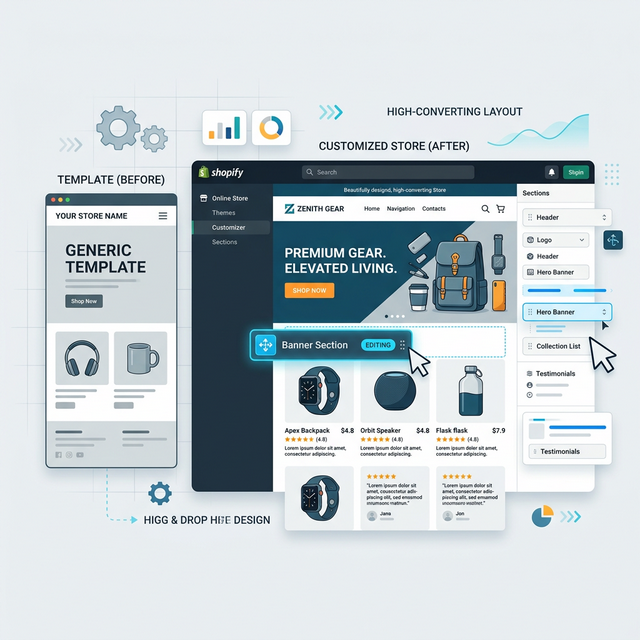
You spend $200 on a premium Shopify theme. You install 15 apps for trust badges, countdown timers, and product reviews. You launch your store.
Three weeks later: 847 visitors, 4 sales, 0.47% conversion rate.
The design looks clean, but nobody is buying because your store looks exactly like the 40,000 other dropshipping stores that launched this month using the exact same generic template.
When your store matches the template, you inherit every negative association buyers have with dropshipping: slow shipping, poor quality, and unreliable service.
Here’s how to build a store design that actually converts.
Branded vs General Store Design
- Branded stores focus on one product or niche. The entire design reinforces a single value proposition. Navigation is minimal. Conversion rates generally range from 2-4%.
- General stores sell multiple unrelated products across categories. The design prioritizes browsing, forcing buyers to evaluate dozens of promises simultaneously. Conversion rates typically sit between 0.5-1.5%.
A branded store selling a problem-solution product with clear before/after messaging at 3.5% conversion will easily outperform a general store with scattered messaging at 0.8%. Pick a core focus and build the brand around it.
The “Above the Fold” Rule
Buyers make purchase decisions in the first visible screen (above the fold). If the value proposition isn’t immediately clear, 68% bounce within 8 seconds.
Everything you need must be immediately visible:
- Product in Use: A vacuum cleaner on a white background converts at 2.1%. That same vacuum in someone’s hand cleaning a mess converts at 4.8%. Show, don’t tell.
- Benefit-Focused Headline: “Cordless Stick Vacuum” (1.9%) vs “Stops Pet Hair from Ruining Your Furniture” (4.2%). Lead with the outcome.
- Price Context: “$79” vs “$79 (Normally $159, Save $80)”. Give them a comparison anchor.
- Visible Social Proof: Place your star rating and review count right next to the price.
- Contrasting CTA Button: “Add to Cart” beats “Buy Now”. Use a high-saturation, contrasting color for the button (like bright orange) even if it “clashes” with your muted brand colors.
Make sure your ad copy flows logically into this landing page experience.
Trust Signals That Work (And Fake Hacks That Don’t)
Every dropshipping store adds trust signals, but most add the wrong ones.
What works:
- Customer Photos: Text-only reviews are fine, but reviews with customer photos increase conversion by 42%. Test static image ads to source user-generated content for your store.
- Specific Shipping Info: “Free shipping on orders over $50 (US only, 10-15 business days)” converts far better than vague “Fast Shipping!” badges.
- Visible Return Policy: Place the return link in your main nav, not buried in the footer.
What actively hurts you:
- Fake “As Seen On” Logos: If CNN didn’t review your posture corrector, don’t put their logo on your site. Buyers check, and lying drops trust to zero.
- Fake Scarcity Counters: “Only 3 left in stock!” that resets every time you refresh the page. Buyers know you’re lying.
- Badge Stuffing: 8+ trust badges under an Add to Cart button looks desperate. Stick to 1-2 recognized payment icons.
The Mobile Friction Problem
60-75% of dropshipping traffic comes from mobile. But most stores are built desktop-first, costing owners thousands in lost sales.
Avoid these mobile killers:
- Tiny Tap Targets: Buttons must be at least 48x48 pixels.
- Horizontal Scrolling: Don’t force users to swipe horizontally through eight gallery images. Stack them vertically.
- Immediate Pop-Ups: A 10% off pop-up that blocks the whole screen before the page even loads causes 68% of users to immediately close the tab. Delay them for 30+ seconds.
- Small Text: Body text under 16px requires pinch-to-zoom on mobile. Make it readable.
- Fixed Headers: A sticky header that covers 25% of the mobile screen while scrolling hides your product.
Fix your mobile friction first, and check out our guide on reducing cart abandonment to streamline your checkout flow.
Frequently Asked Questions
Should I use a branded or general store design for dropshipping?
Branded stores limit options to one core product or niche and typically convert at 2-4%. General stores feature multiple unrelated products and convert at 0.5-1.5%. Branded stores are easier to scale.
What product page elements increase conversion rates?
Above the fold: product in use (not isolated on white), benefit-focused headline, price with savings context, visible star ratings, and a contrasting CTA button.
Why does my dropshipping store convert better on desktop than mobile?
Mobile traffic constitutes 60-75% of your users. Issues like tiny tap targets, horizontal scrolling, intrusive pop-ups, and text under 16px destroy mobile conversion.
Which trust signals actually increase dropshipping conversions?
Customer photos in reviews (+42%), a real founder photo, specific shipping timelines, and a visible return policy. Fake scarcity timers and ten generic trust badges actually hurt conversions.