How to Find Reliable Dropshipping Suppliers with Fast Shipping (2026)
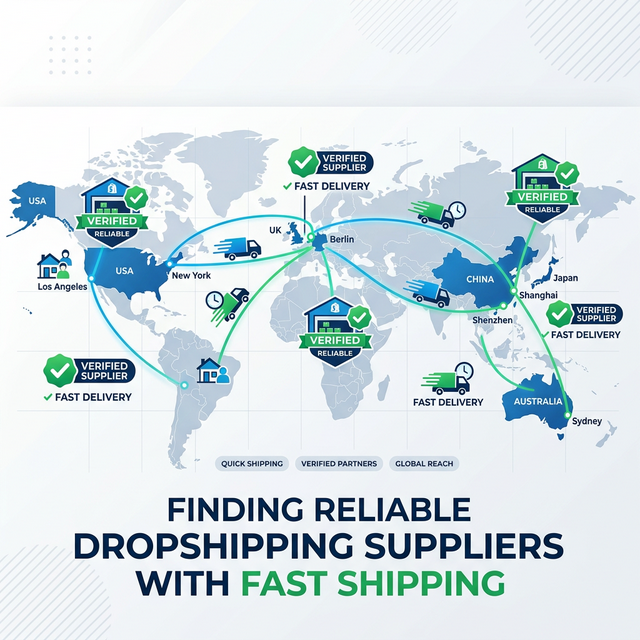
Your ads are running, orders are coming in — then the complaints start. “Where’s my order?” “This looks nothing like the photo.” One bad supplier can tank your reputation, spike refunds, and destroy months of profitable scaling.
Finding reliable suppliers isn’t about the lowest price. It’s about protecting your margins through consistent quality, fast shipping, and dependable communication.
What Makes a Supplier Reliable
Most dropshippers choose suppliers on price alone. A supplier charges $8 instead of $12, so it seems obvious. But that $4 savings disappears when shipping takes 4 weeks, 15% of orders arrive damaged, and customer service eats 2 hours of your day.
The five things that actually matter:
- Shipping speed — the #1 reliability metric. Customers tolerate paying $3 more, but not waiting 25 days. Target 1-3 day processing and 5-10 day delivery.
- Quality consistency — not just one good sample, but consistent quality across hundreds of orders. Ask suppliers about their defect rates (1-3% is good).
- Communication — send a test message at 10 AM EST. If they respond within 2-4 hours with specifics, they’re solid. If you wait 48 hours for a vague “we check” reply, expect constant issues.
- Inventory accuracy — reliable suppliers update stock in real-time and notify you when levels drop below 50-100 units.
- Transparent pricing — no surprise “handling fees” or “remote area surcharges” after you’ve committed. All-in pricing upfront.
How to Vet Suppliers Before Committing
Never commit without testing. Here’s the process:
- Order 3-5 samples to different addresses (your home, a friend, a different state). Track exact timelines.
- Evaluate packaging — does it arrive with proper protection, or is the product loose in a poly mailer? Photo everything.
- Verify shipping claims — if they promise “2-3 day processing + 7-10 day delivery,” samples should arrive in 9-13 days. If they consistently take 20+ days, move on.
- Place a 10-20 unit test order — this tests volume handling, not cherry-picked samples.
- Stress-test communication — ask detailed questions, request tracking updates, report a minor issue. How they handle small pressure = how they’ll handle real problems at 50 orders/day.
Score each supplier 1-10 on speed, quality, communication, inventory, and pricing. Drop anyone below 7 in any category.
Comparing Supplier Platforms
| Platform | Shipping | Cost | Best For |
|---|---|---|---|
| Zendrop | 7-12 days (US warehouse) | $49-299/mo + higher product cost | Best-sellers where speed matters |
| CJDropshipping | 12-20 days (China) | No monthly fee, lower product cost | Product testing and lower-margin items |
| Spocket | 2-5 days (US/EU) | Higher product cost (40-60% premium) | Speed-first stores |
| AutoDS | Varies (multi-source) | $29-299/mo | Managing 5+ suppliers from one dashboard |
The move most profitable stores make: use Zendrop/Spocket for top sellers where fast shipping justifies the cost, CJ for testing new products, and AutoDS when you’re scaling past 100+ daily orders.
Finding Suppliers Outside Platforms
Platform suppliers are convenient but not always optimal. Going direct can dramatically improve margins.
- Alibaba — filter by “Trade Assurance” and “Verified Supplier,” then contact 10-15 factories. About 20-30% will work with dropshipping if you commit to testing volume.
- Reverse image search — take a competitor’s product photo, run it through Google Images or TinEye, and find the original supplier listing.
- Specialized networks — Printful for print-on-demand, Printify for custom merch, or niche wholesale platforms for specific categories.
- Supplier directories — SaleHoo ($67-299/year) pre-vets suppliers and filters out scammers. You still need to test them yourself.
Once you’re doing 50-100 units/month of a specific item, contact the manufacturer directly. Offer minimum monthly volumes in exchange for better pricing and priority fulfillment.
Communication Red Flags
Walk away immediately when you see:
- Vague answers — you ask about processing time and get “very fast, good quality” instead of actual numbers
- High-pressure sales — “special price today only!” means they’re hiding something
- Surprise fees — $2/unit “handling charge” that wasn’t in the original quote
- Fake tracking — numbers that don’t exist in the carrier system or don’t update for a week
- Blame-shifting — “customer entered wrong address” when you can see the correct address in your system
- Ghosting after commitment — responsive during vetting, then 3-4 day response times once you start ordering
Building a Backup Supplier System
Single-supplier dependency is a business risk. One stockout or quality drop can kill your revenue overnight.
Focus on your top 5-10 products (the Pareto principle — they likely drive 60-80% of revenue). For each:
- Qualify 2-3 backup suppliers
- Send them 5-10 orders/month to keep the relationship warm
- Document exact specs (photos, measurements, materials, packaging) so customers notice zero difference if you switch
- Set performance triggers — if primary shipping exceeds 5 days for 15%+ of orders, or defect rates hit 5%+, start shifting volume
Review supplier scorecards monthly. If a backup outperforms your primary, consider swapping. If both are declining, start qualifying replacements before problems snowball.
Key Takeaways
- Shipping speed matters more than product cost — customers complain about delays, not $3 price differences
- Always vet with real orders (3-5 samples + a 10-20 unit test batch) before committing
- Use multiple platforms: fast shipping for best-sellers, cost-effective for testing
- Go direct to manufacturers once you’re doing 50+ units/month for better margins
- Maintain 2-3 backup suppliers for your top revenue products and test them monthly
Frequently Asked Questions
How do I vet a dropshipping supplier before committing?
Order 3-5 samples to different addresses, test shipping times, and rate suppliers on speed, quality, communication, inventory accuracy, and pricing transparency. Only commit to suppliers scoring 7+ across all categories.
Which platform is best for fast shipping?
Zendrop and Spocket offer US/EU warehouses with 2-12 day shipping but cost 20-60% more. CJDropshipping is cheaper with 12-20 day China shipping. Most successful stores use multiple platforms.
What are red flags when talking to suppliers?
Vague answers, high-pressure sales, surprise fees, fake tracking numbers, blaming customers for their mistakes, or ghosting you after you start ordering.
Do I need backup suppliers?
Yes — for your top 5-10 revenue products. Qualify 2-3 backups for each and test them with small monthly orders so they're ready to scale when needed.