Best Dropshipping Product Research Tools & Free Validation Methods (2026)
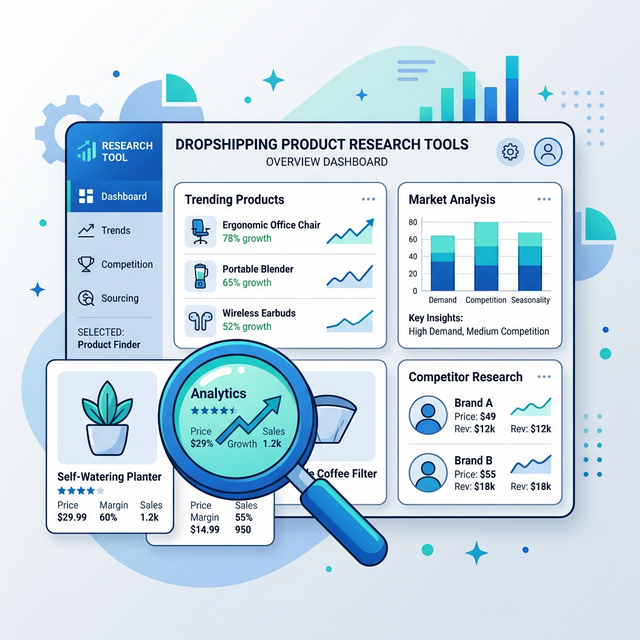
You spend $200 on product research tools. You swipe ads. You check Facebook Library daily. You find a product with 500K TikTok views and test it immediately.
The ad dies in 96 hours with zero profitable sales.
The problem isn’t your creative. Every product research tool showed you what was already saturated. By the time a product hits ad spy tools or goes viral, hundreds of stores launched it weeks ago.
Most product research tools don’t validate demand—they validate competition.
Why Spy Tools Fail You
Product research tools show lagging indicators. Ad spy tools scrape ads that are already running. That means those products have already been tested, validated, and scaled by someone else. You’re getting old information packaged as “trending.”
Winning products have a predictable lifecycle:
- Discovery (Weeks 1-2): A few stores test it. Margins are incredible.
- Growth (Weeks 3-6): Product gains traction. CPMs stay healthy.
- Saturation (Weeks 7-10): Everyone is selling it. CPMs spike massively.
- Death (Week 11+): Only loss-making ads remain.
Spy tools show you products during the Saturation or Death phase. A product with 2 million views means 200 dropshippers are already battling for clicks. You’re entering a bidding war with burned-out audiences. Use spy tools to understand how to sell, not what to sell. Check our guide on spying on competitors the right way.
Free Validation Methods That Actually Work
Real validation comes from obsessive, free research that reveals buyer intent before products trend publicly.
1. Reddit and Forums
Spend 6+ hours reading threads in your niche. Not to find “insights” to screenshot, but to absorb the exact language customers use. When you see the same problem mentioned 12+ times across different threads (“I hate when X does Y”), there’s demand.
2. Amazon Reviews (1-Star and 3-Star)
Read 50+ reviews on competing products to find what created buyer’s remorse. If 18 out of 50 reviews complain about a specific flaw, solve it. That’s your differentiation.
3. TikTok Creative Center
The TikTok Creative Center shows trending paid ads by industry. It filters for ads getting meaningful engagement right now. See what hooks work today, not three months ago. Use this for creative inspiration, not product copying. Learn more about static vs video creatives.
4. Facebook Ad Library
Filter for ads running 30+ days. Unprofitable ads get killed quickly. If an ad runs for two months, it’s making money. Study the angle, not the product.
5. Google Keyword Planner
Use Google Keyword Planner to check search volume. Zero monthly searches = no demand. 2K-10K searches = existing demand you can capture.
When Paid Tools Are Actually Worth It
Skip paid tools until you’re profitably spending $1,000+/month on ads.
- Adspy / Dropship Spy: Better for scaling operators testing 5-10 products monthly to quickly check engagement metrics.
- SimilarWeb: Use the free tier to estimate competitor traffic. A store with 10K+ monthly visits is worth studying; 800 visits is not.
- Koala Inspector: A free Chrome extension to peek at competitor Shopify apps and themes.
Invest time instead of money. Your first few product tests should teach you how to research.
6 Red Flags That a Product Will Fail
Spot these during your research to save yourself testing budget:
- Nobody complains about the problem: If there are no Reddit threads or angry Amazon reviews, people don’t care enough to buy a solution.
- Only dropshippers are talking about it: Real demand sounds like “how do I fix X”. Fake demand sounds like “is this product a winner?”
- Existing reviews say “doesn’t work”: Don’t sell junk. You can’t market your way out of a bad product. Find reliable suppliers instead.
- Search volume under 500/mo: Minimal existing demand.
- Identical competitor ads: If every store uses the exact same angle and footage, you have no differentiation limit. You’ll compete purely on price.
- 14+ day shipping for generic items: Customers tolerate long shipping for unique items. They won’t wait 18 days for something available on Amazon Prime.
If you spot three or more red flags, move on. No amount of good ad copy rescues a product nobody wants.
Frequently Asked Questions
How do I validate a dropshipping product before spending money on ads?
Use free research: Spend 6+ hours reading Reddit threads (12+ mentions of a pain point = demand). Read 50+ Amazon reviews to find product gaps. Check Google Keyword for 2K-10K searches.
Are paid product research tools like Adspy worth it for beginners?
Skip paid tools until spending $1,000+/month on ads. Free methods provide 80% of the data. Save your money for ad testing.
Why do products from spy tools always fail when I test them?
Spy tools show lagging indicators. By the time a product appears, it's saturated. You're competing with burned audiences and $35-50 CPMs instead of $15-20.
What free tools actually validate product demand?
Reddit shows buyer intent. Amazon reviews reveal gaps. TikTok Creative Center shows formatting. Google Keyword Planner proves search volume. SimilarWeb estimates traffic.
How long should I spend researching before testing a product?
Spend 6-12 hours researching before spending $50 on testing ads. If you spend 30 minutes researching and $500 testing, you burn money.