How to Spy on Competitors' Dropshipping Products: 7 Free Tools (2026)
Scrolling TikTok for three hours looking for “viral” products gives you the same saturated items everyone else is already selling. By the time a product hits your feed, 50 stores launched it two weeks ago.
The stores making money aren’t finding products on TikTok. They’re watching what’s already working for competitors — analyzing what sells, understanding why, and finding better angles.
Why TikTok Product Research Is Dead
When a product hits 500k+ views, hundreds of dropshippers add it to their store that same week. You’re not discovering a trend — you’re joining a stampede.
The timeline kills profitability:
- Discovery — first few stores test it, margins are high
- Growth — product gains traction, CPM around $15
- Saturation — everyone’s selling it, CPM spikes to $35-50
- Death — burned out, only loss-making ads remain
When you find a product on TikTok, you’re entering at saturation. Many “product showcase” accounts are even run by AliExpress suppliers trying to generate dropshipper demand — the views come from other dropshippers, not real customers.
The 5 Data Points That Actually Matter
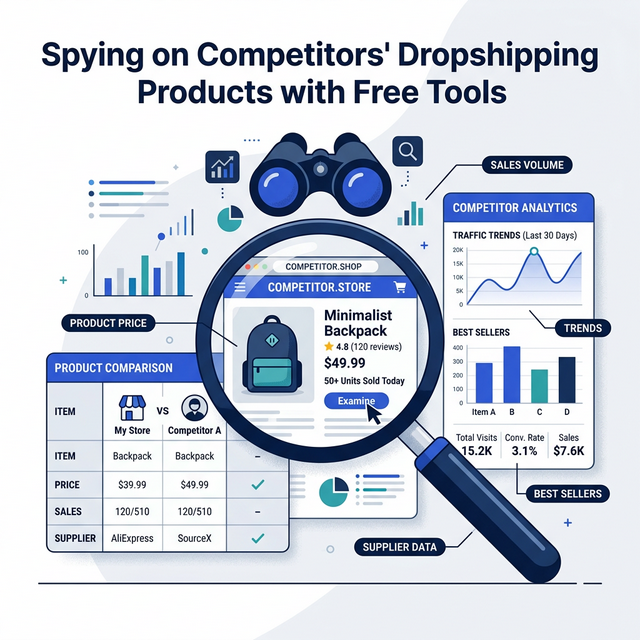
- Store traffic — use SimilarWeb to check. A store with 10k+ monthly visits is worth analyzing. Under 5k? Probably not profitable enough to learn from.
- Ad creative longevity — if a competitor runs the same 2-3 creatives for 30+ days, those creatives work. 15 different videos over 2 weeks = still testing.
- Pricing strategy — if most competitors sell at $29.99 but one charges $49.99 with similar traffic, study their differentiation.
- Product bundling — a $24.99 phone case bundled with accessories for $39.99 = 3x markup. The bundle is the real product.
- Shopping ads presence — if a product appears in Google Shopping, the ROI justifies the ad spend.
7 Free Research Methods
1. Facebook Ad Library
Search competitor store names at facebook.com/ads/library. Any ad running 30+ days is probably profitable — advertisers kill losers within days. Study the copy, creative, and offer structure of long-runners.
2. Google Shopping
Search a competitor’s name plus product terms. Products in Shopping results are the ones they’re paying to promote — meaning those products justify the ad spend.
3. Wayback Machine
Pull up a competitor’s store on archive.org from 6 months ago. Products that disappeared = failures. Products that stayed and got more prominent = winners.
4. AliExpress Orders Filter
Search a product category, filter by “Orders,” sort high to low. Products with 5,000+ orders in the last month have real demand. Cross-reference with recently updated supplier photos — if a supplier updated media and orders spiked, dropshippers are driving that volume.
5. TikTok Creative Center
TikTok Creative Center shows trending paid ad creatives by industry and region. Filter for e-commerce, select your target country, sort by top ads in 7 days. Paid ad performance ≠ organic virality — paid success proves purchase intent.
6. Koala Inspector
This free Chrome extension reveals the theme, apps, and products on any Shopify store. If 10 profitable stores all use the same reviews app, that app probably converts better than alternatives.
7. Ad Comment Analysis
Read the top 20 comments on competitor ads (sort by “Most Relevant”). Positive comments reveal what resonates. Negative comments expose objections you can address proactively in your own copy.
When Paid Tools Are Worth It
| Tool | Cost | Best For |
|---|---|---|
| Adspy | $149/mo | Facebook/TikTok ad monitoring with engagement data |
| Dropship Spy | $47/mo | Aggregated winning products with revenue estimates |
| EcomHunt | Free + $29/mo premium | Daily product picks with ad copy suggestions |
The threshold: don’t pay for spy tools until you’re spending $1,000+/month on ads. Below that, free methods give you 80% of the data. One winning product found through a spy tool can return 60x the monthly cost — but only if you’re testing enough products to find it.
Caveat: everyone using these tools sees the same products. Use them for category research and creative inspiration, not as your primary product source. If a product appears as “winning” on Dropship Spy, hundreds of stores already launched it.
Reverse Engineering Product Pages
Screenshot 5-10 competitor pages for the same product. Look for patterns:
- Benefit-driven headlines (not feature lists)
- Lifestyle images showing the product in use
- Customer photos in reviews (social proof)
- Risk-reversal — money-back guarantee, satisfaction promise
- Urgency elements — limited stock, high demand notices
Whatever appears on 8/10 competitor pages but not yours is likely boosting their conversion rate. The ratio on high-converting pages is typically 3:1 benefits to features — if your description is 80% specs, you’re not selling effectively.
Copy Smart, Not Exact
- Copy the structure — page layouts, section order, email timing. These are proven frameworks.
- Don’t copy the exact product when 40+ stores already sell it — you need differentiation (better creative, stronger angle, bundled offer, or faster shipping).
- Don’t steal creatives — Facebook detects duplicates and tanks reach. Identify what works (the hook, the demo, the testimonial) then create your own version.
- Find gaps competitors miss — if everyone targets women 25-35, test women 45-60. If everyone uses the same angle, try a different one.
Key Takeaways
- TikTok finds products at saturation, not during the profitable discovery phase
- Free tools (Facebook Ad Library, Google Shopping, AliExpress orders, Wayback Machine) provide 80% of what paid tools offer
- Paid spy tools only justify their cost at $1,000+/month ad spend
- Study competitor ad creative for hook structure, thumbnail effectiveness, and winning angles
- Copy frameworks and structures but differentiate on product angle, creative execution, or target audience
Frequently Asked Questions
How do I spy on competitors' dropshipping products for free?
Use Facebook Ad Library to find ads running 30+ days (a sign of profitability), Google Shopping to see what competitors pay to promote, Wayback Machine to track store changes over time, and AliExpress orders filter to find high-volume products.
Are paid product spy tools worth it?
Only when you're spending $1,000+/month on ads. Below that, free methods give you 80% of the data. Once scaling, tools like Adspy ($149/mo) save time and reveal engagement metrics that free methods can't access.
Why doesn't TikTok product research work anymore?
By the time a product hits 500k+ views, hundreds of dropshippers launch it simultaneously. You're entering at saturation when ad costs spike from $15 to $35-50 CPM. Profitable stores find products during the discovery phase, not after they trend.
How can I tell if a competitor's product is actually profitable?
Check if their ads run 30+ days, verify traffic exceeds 10k monthly visits via SimilarWeb, and look for products with multiple creative variations narrowing to 2-3 long-running winners.