Subscription Payment Failures in Dropshipping: Reduce Churn by 30%
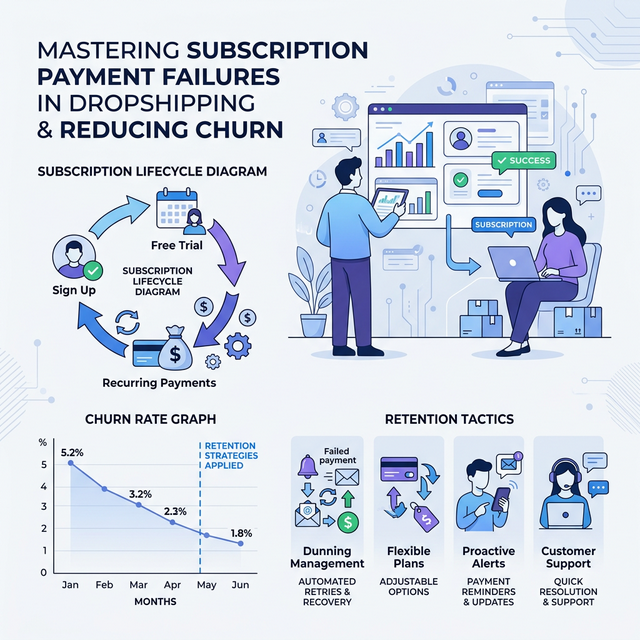
You’ve built a successful subscription dropshipping business. Revenue is growing month-over-month. Everything looks perfect on paper.
Then you check your payment reports and realize you’re bleeding thousands of dollars every month because cards are declining.
Failed recurring payments are the hidden tax of subscription revenue. If you don’t have the right systems in place, they can eat 10-30% of your monthly revenue. Even in standard checkouts, reducing cart abandonment is critical, but for recurring revenue, saving failed payments is the absolute highest leverage activity you can do.
Why Subscription Payments Fail (The Real Numbers)
The average subscription business sees a 15-20% failure rate on recurring payments. For a business doing $20,000 MRR, that’s $3,000-$4,000 at risk every single month.
Why do they fail?
- Expired cards (30-35%) — Customers get new cards but forget to update their info.
- Insufficient funds (20-25%) — Common on the 1st of the month when rent hits.
- Fraud blocks (15-20%) — Banks aggressively block recurring charges they deem suspicious.
- Other (20-30%) — Network timeouts, spending limits, account closures.
Payment Processors: Shopify vs. Stripe vs. Chargebee
Your payment processor choice directly impacts how many failed payments you recover.
Shopify Payments is convenient but basic. It retries failed payments 4 times over 23 days, then gives up. It’s adequate for small operations, but you lack control over timing.
Stripe offers more flexibility. You can configure smart retry logic that adapts to the decline reason (e.g., retrying “insufficient funds” 3 days later instead of the next day). Stripe also supports automatic card updater services.
Specialized billing platforms like Chargebee, Maxio, or Recurly are built specifically for subscriptions. They feature advanced dunning, multi-processor orchestration, and smart analytics.
The Rule: Under $10,000 MRR? Stick with Shopify Payments or Stripe. Over $10k MRR? The 0.5-1% fee you pay to Chargebee is instantly offset by the 15-25% more failed payments they recover.
Dunning Strategies That Actually Recover Revenue
Dunning is the process of prompting customers to update failed payment info. Sending one generic email doesn’t work. Effective dunning requires a multi-touchpoint sequence:
- Immediate Email: Send immediately when payment fails. Be helpful, not accusatory (“We had trouble processing your payment” vs “Your payment failed”). Include a direct link to update the card.
- Day 3 Email: Add urgency. “Your subscription pauses in 4 days unless you update your payment info.”
- Day 2 (SMS): SMS has 5-10x the open rate of email. Send a brief text to mobile numbers: “Update your payment info to keep your subscription active: [Link]”. This recovers an extra 10-15%.
- Final 24-Hour Email: Send right before cancellation. Businesses often see a 20-30% recovery rate here when customers realize they’ll actually lose access.
Smart Retry Logic: Timing Is Everything
Don’t retry failed payments randomly. If you hit an empty bank account 4 days in a row, you just rack up decline fees.
- Insufficient funds: Wait 3-5 days. Retrying the next day is pointless. Avoid retrying on the 1st of the month (when rent is due).
- Expired cards: Enable Account Updater services through Visa/Mastercard (via your processor). This automatically pulls the new card details. Retry immediately.
- Fraud blocks: Wait 7-10 days to give the customer time to approve the charge with their bank.
Set a maximum of 4-5 retries over 21-30 days. Beyond that, recovery drops below 2%.
Alternative Payments Reduce Failure Rates
Credit and debit cards fail. Offering alternative ways to pay can drop your failure rate by 20-40%.
- PayPal pulls from the user’s PayPal balance first, then backup methods. Adding it can reduce churn by 10-15%.
- Apple Pay & Google Pay feature built-in token updaters. When a customer gets a new physical card, the digital token updates automatically. Expired card failures drop to zero.
- ACH/Bank Transfers work beautifully for $100+/mo subscriptions. Bank accounts don’t expire every 3 years like cards do.
- Buy Now, Pay Later (BNPL) like Klarna or Affirm are fantastic for annual subscriptions. You get paid upfront, and the BNPL provider eats the failure risk.
Metrics You Must Track Weekly
Don’t wait for the monthly P&L to spot a payment emergency. Track these weekly:
- Involuntary churn rate: Customers lost to failed payments. Keep this below 5%. Above 10% = billing crisis.
- Retry success rate: Aim for 40-60%.
- Decline distribution: If 50% are expired cards, you need better updater coverage.
- Revenue recovery rate: Elite businesses recover 50-60% of initially failed revenue.
Payment failures are entirely solvable. Stop losing $3,000/month to basic mechanical errors. Fix your retries, set up SMS dunning, and turn on PayPal.
Frequently Asked Questions
What percentage of subscription payments typically fail?
The average subscription business experiences a 15-20% failure rate on recurring payments. Expired cards cause 30-35%, insufficient funds 20-25%, and fraud blocks 15-20%.
When should I switch from Shopify Payments to a specialized billing platform?
Consider specialized platforms like Chargebee or Recurly when you exceed $10,000 MRR. They recover 15-25% more failed payments through smart dunning.
How long should I wait before retrying a failed payment?
For insufficient funds, wait 3-5 days. For expired cards (using card updater services), retry immediately. For fraud blocks, wait 7-10 days.
Do SMS reminders improve payment recovery rates?
Yes. SMS reminders have 5-10x higher open rates than email, helping recover an additional 10-15% of failed payments.
What's the best alternative payment method to reduce failures?
PayPal reduces churn by 10-15%. Apple Pay and Google Pay eliminate expired card failures through built-in card updater functionality.