How to Write Dropshipping Ad Copy That Converts (5 Proven Formulas)
Your dropshipping ad spend doesn’t fail because you picked the wrong product. It fails because your ad copy sounds exactly like everyone else’s.
“Are you tired of…?” “Introducing the revolutionary…” “Limited time offer!”
Customers scroll past these ads without reading a word. Why? Because they’ve seen this exact copy 50 times already. Before writing ads, ensure you’re promoting items with real demand by tracking platform signals.
The difference between profitable ads and money-burning ads is whether your copy stops the scroll in the first 3 seconds.
Why Dropshipping Copy Fails in 3 Seconds
Facebook and TikTok users scroll at 300-400 pixels per second. Your ad appears for ~1.2 seconds.
If your hook looks generic, their brain categorizes it as “advertising noise” and keeps moving.
Pattern recognition kills generic copy. When someone sees “Are you tired of…”, they already know it’s an ad and dismiss it. Testing 200+ ad variations shows that ads using common hook patterns have 60-75% higher CPC than ads with unique openings. Study what’s working by spying on competitor ads to identify successful patterns without copying them.
Weak hook: “Are you struggling with back pain?” (Brain instantly dismisses) Strong hook: “8 out of 10 people sitting right now will have back pain by tonight.” (Forces a pause to evaluate)
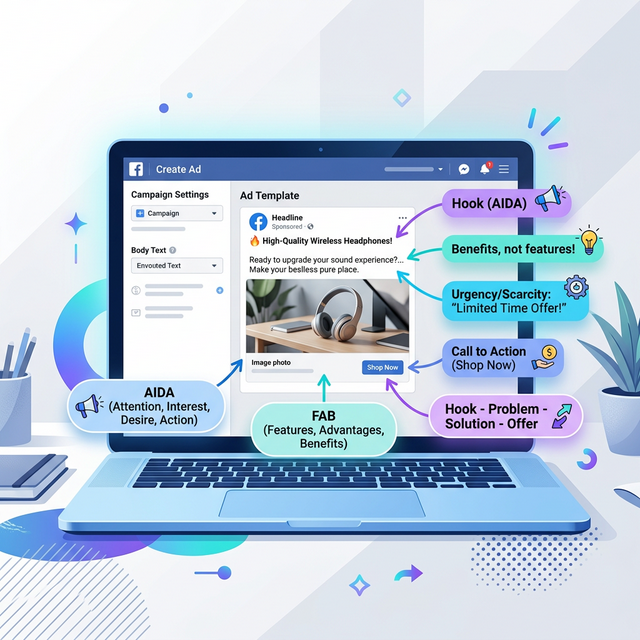
The Hook-Problem-Solution Structure
Profitable dropshipping copy works best with a three-part structure:
- Hook (3 seconds to stop scroll)
- Problem agitation (15 seconds to build urgency)
- Solution (10 seconds to present product & CTA)
Total reading time should average 25-30 seconds.
The hook must contain specificity, not generic questions. “Most people trying to lose weight make the same mistake in week 2” forces the brain to wonder what mistake.
Problem agitation connects pain to their current situation. Make the reader slightly uncomfortable by describing their exact reality. “You adjust your sitting position 6-8 times per hour…” is much better than “Back pain hurts.”
Solution presentation focuses on outcomes, not features. Customers buy “sitting through an 8-hour workday without pain,” not “ergonomic mesh design with lumbar support.”
4 Hook Formulas That Stop the Scroll
Testing across 500+ ad variations shows these patterns consistently outperform generic questions:
- Specific statistic: “73% of dropshippers quit in month 4 because of this supplier mistake.”
- Unexpected time frame: “The first 48 hours after launching a product determine if it’s profitable.”
- False belief: “Everyone says ‘test 10 products’ to find a winner. That’s backwards.”
- Customer quote: “I thought this was fine until I saw the 3-star review mentioning durability.”
Each pattern breaks the auto-scrolling habit. The specific hook filters for the right audience, reducing cheap (pointless) impressions and securing high-intent clicks.
Writing Problem Agitation Without Being Salesy
Problem agitation describes the customer’s current experience in detail without exaggeration. The goal is recognition, not fear.
Weak: “Back pain is terrible and affects millions.” Strong: “At 11 AM you’re comfortable. By 2 PM the lower back ache starts. By 4 PM you’re standing at your desk because sitting hurts.”
Effective agitation follows this formula: [Current painful pattern] + [Acknowledge frustration] + [Why common solutions fail].
By explaining why previous solutions failed, you create an opening for your product to be the true fix.
Sell Transformations, Not Features
Customers don’t process feature lists — they process transformation stories.
- Feature-focused: “Ergonomic design, breathable mesh, 360-degree rotation.”
- Transformation-focused: “Your back stays aligned all day. You finish an 8-hour shift with the same comfort you had at 9 AM.”
Use specific timeframes. “Notice reduced stiffness within 3 days of wearing 30 minutes daily” gives them a testable expectation. Honest timelines convert better than exaggerated promises. Use tools like Hemingway App to ensure your copy is punchy and easy to read.
Social Proof & Urgency That Actually Work
Generic 5-star reviews (“Love it!”) add zero value. Use specific reviews with context:
“Office worker here. Wore this 30 min/day for a week. The afternoon slouch I usually fight is just… gone. Genuinely surprised.”
This review includes a use case, timeframe, measured outcome, and sounds realistic.
Urgency only works when it’s true:
- Fake: “Only 50 left! Order now!” (Countdown resets every day)
- Real: “We restock every 3 weeks. Current batch sells out in 4-6 days based on the last 3 months.”
Information-based urgency converts better than pressure-based lies because it respects the customer’s intelligence.
Ad Copy Length Rules
Length should match decision complexity and price point:
- Under $30: 50-75 words (Impulse buy)
- $30 - $100: 100-150 words (Considered purchase)
- Over $100: 150-200+ words (High-ticket)
Cold vs. Warm Traffic: Cold traffic needs 30-50% longer copy. They need context and proof. Retargeting (warm) audiences just need a reminder and a gentle nudge.
Key Takeaways
- Hook specificity (stats, timeframes, quotes) beats generic questions every time.
- Problem agitation should describe the customer’s exact experience without exaggeration.
- Sell outcomes and specific timeframes, not product features.
- Social proof requires specific context (use case, timeline, measurable change).
- Real urgency informs with data; fake urgency destroys trust.
- Pair your optimized copy with high-converting store design for maximum impact.
Frequently Asked Questions
How long should Facebook ad copy be for dropshipping?
For products under $30, aim for 50-75 words. Products $30-100 need 100-150 words. High-ticket items above $100 require 150-200+ words. Cold traffic needs 30-50% longer copy than warm retargeting traffic.
What makes a good hook for dropshipping ads?
High-performing hooks use specific statistics, unexpected time frames, false beliefs, or customer quotes. Avoid generic questions like 'Are you tired of...' which trigger instant scroll-past.
Should I use urgency in my ad copy?
Use urgency only when it's true and specific. Real urgency provides verifiable data (e.g., 'restock every 3 weeks'). Fake urgency like countdown timers that never end destroy trust.
What's the difference between features and benefits in ad copy?
Features describe what the product is. Benefits describe what changes in the customer's life. Always lead with benefits and use features only as proof that the benefit is achievable.